
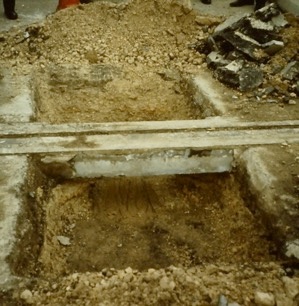
Rotherham bus station, 1996. LR55 track spanning a one-metre excavation, inspected by the statutory undertakers and HMRI with buses running over it. From the Trampower field report linked below.
Dave,
Dear all,
I am attaching Technical Memorandum 08, Modern Tram Track Construction, from the Bristol Area Bus and Tram Business Case, and asking whether you would be willing to read it and tell me what is wrong with it.
It is a draft. I want to be clear about that at the outset, because the document does not shout it and it may well be forwarded on. It is not finished, it is not the Association’s settled view, and it should not be quoted as either. It is being circulated because the people on this list know more about tram track than anyone else I can ask, and I would far rather hear what is wrong from you than from someone at the Department later.
What it is for. It is written as a guide for a promoting authority that has never built a tramway: what the trackform options are, what governs the choice between them, and what buried services do to the sequence and the cost. It is not an academic paper. It does not need to be perfect. It does need to avoid saying anything that is plainly wrong.
The position it takes, so that you know what you are testing. The default is full diversion of the services that conflict with the tramway before construction, with the diversion trench then providing the foundation, so that divert-then-lay is one sequence rather than two competing options. It does not reject modern shallow trackforms, which are a real advance. What it declines to rely on, pending evidence, is the narrower proposition that removability offers a satisfactory alternative to dealing with the services at the outset.
One substantial thing has been added since earlier drafts, and it is the part I would most like attacked.
Section 8 sets out the arithmetic of retained utilities: how often a third party has to open the carriageway before the closures consume the saving from not diverting. Until this month the frequency of those openings was the one input in it that rested on nothing at all. Bristol City Council has now kindly supplied the street works permit record for the whole A38 corridor, six financial years of it, and the measured rate is about 4.7 third-party carriageway openings per kilometre per year.
What the record does not tell us is how many of those would fall within the part of the carriageway a tramway would occupy, and that proportion governs the whole result. The memorandum therefore states the answer as a threshold rather than as a figure: retaining the apparatus is the cheaper course only if fewer than about 18 per cent of recorded openings intersect the running way, or fewer than about 48 per cent on a harsher assumption about diversion cost. Establishing the real proportion is the obvious next measurement, and it is one a promoter can make.
The appendix is explicitly a method rather than an answer. Every input is provisional, and WECA could replace all of them with surveyed alignment data, actual utility positions and properly modelled disruption costs when it comes to the business case. Our job is to show what needs testing, why it matters, and what data will settle it.
What would help most.
Anything factually wrong, however small. Anything overstated, where a claim is carried further than the evidence supports. Anywhere the engineering is simply not how it is done. And anywhere a promoting authority would be misled by what it says.
If it is easier to mark up the document than to write an email, please do. Tracked changes or a different colour are ideal, and a scribbled PDF is just as welcome. A rewritten sentence is worth a great deal more to me than a note saying a paragraph does not work, because I can absorb the first in seconds and have to reconstruct the second.
One note on the manufacturers named in it. Waybeam, PCAT, TIG/m and LR55 all appear, and in each case the account given is the developer’s own, described as such. Each has been sent the passages that concern them, and one has already corrected me on two points, which is the whole reason for doing it that way round.
No deadline and no obligation.
With thanks,
David Andrews C. Eng
Chair, LRTA Campaigns Group
Lead Author, Bristol Area Bus and Tram Business Case
tyningroad@gmail.com · 07795 842295
https://claverton-energy.com/cms4/wp-content/uploads/2026/08/LR55-Rotherham-Installation.pdf
